AWS
Agent DataSphere
An agentic AI platform with 17k lines of Python in production. An orchestrator agent on Amazon Bedrock and Claude combines semantic search, knowledge-graph reasoning, and conversation memory.
- Role
- Solutions Architect AI/ML Intern
- When
- May–Aug 2026
17k
lines of Python across ~100 modules
3.4k
line React front end
10+
AWS services in the live deployment
Situation
AI agents are only as good as the context they can reason over, and an organization’s context is scattered across data lakes, warehouses, lakehouses, databases, and streams, and in knowledge no one has written down. Until agents can reach that context safely, their decisions can’t be trusted. Senior AWS solutions architects and engineers were shaping the idea for Agent DataSphere: a knowledge-graph agent platform that acts as the semantic and context layer of an agentic data lake, so AI agents can find, understand, and trust an organization’s data. The closest public example today is AWS Context, which AWS announced in June 2026.
Task
I was given the task of building the MVP: a working prototype of Agent DataSphere. I built the platform from scratch, with four core deliverables: an unstructured-data pipeline, a searchable knowledge base, a question-answering agent, and a human-in-the-loop interface.
Action
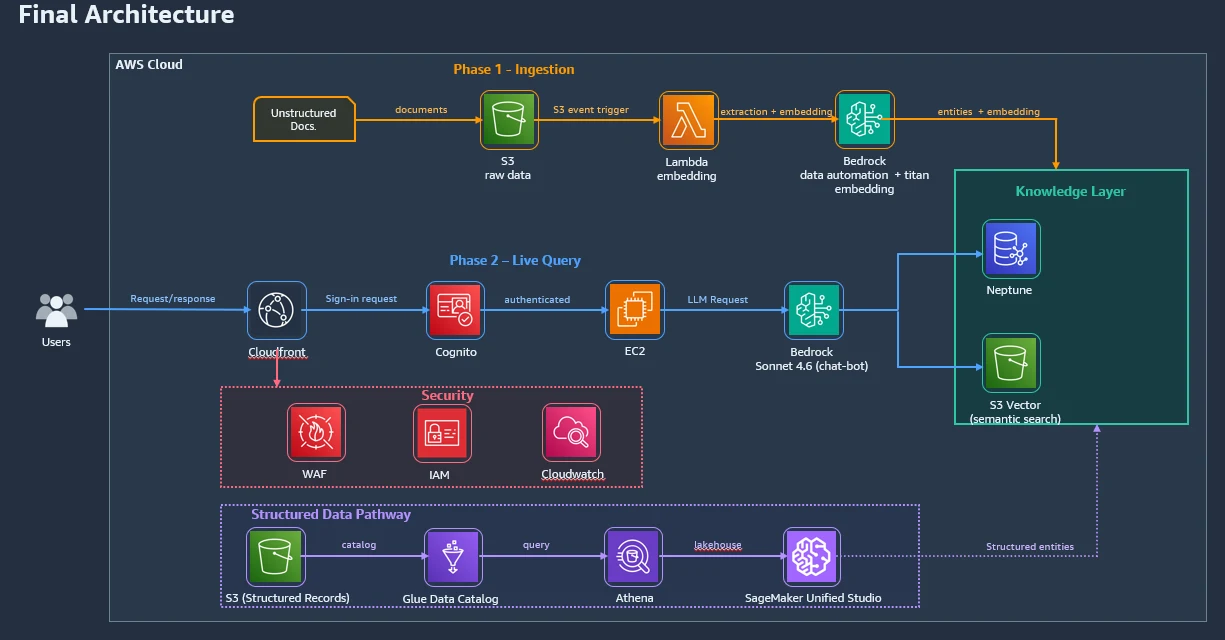
- Built document ingestion that parses text, Markdown, JSON, and CSV files, extracts entities and relationships, and merges them into an Amazon Neptune knowledge graph, with uploads through S3 presigned URLs.
- Built the embedding pipeline and vector index on Amazon S3 Vectors (chosen over OpenSearch to reduce cost), behind a semantic search API that also returns related graph entities.
- Wrote the orchestrator agent: a tool-use loop on Amazon Bedrock and Claude that decides, per question, whether to search documents, traverse the graph, or both in parallel, with runtime model selection and a deterministic fallback so it never hard-fails.
- Built a React interface for people to review and correct the graph: create, edit, and delete entities and relationships, with per-entity history, an audit log in DynamoDB, and one-click revert.
- Developed MCP and A2A integrations connecting the agents to enterprise applications, APIs, and data platforms.
- Deployed the full stack on AWS: an EC2 app server behind an Application Load Balancer with an Elastic IP and TLS, CloudFront and AWS WAF at the edge, Amazon Cognito sign-in with Lambda@Edge authorization, least-privilege IAM, and Neptune provisioned through CloudFormation, all with repeatable deploy scripts.
- Added an evaluation harness that scores gold questions on document hit rate, entity recall, phrase coverage, and groundedness, and measures p50/p95/p99 latency per pipeline stage, publishable to CloudWatch as a regression guard.
Result
- Delivered all core deliverables (the unstructured-data pipeline, the semantic-search knowledge base, the question-answering agent, and the human-in-the-loop interface), then went past scope with a production deployment, enterprise security, cross-source BI reports with source citations, and full auditability.
- Shipped about 17,000 lines of Python across roughly 100 modules and a 3,400-line React front end, running live on AWS.
- Every answer shows its provenance (tool calls, per-stage timings, and the engine used), and CloudWatch dashboards and a live status page watch the deployment.
- Wrote the architecture diagrams and design docs, then presented and defended the design with a live demo in two internship review rounds.
More from this role
Five AWS certifications in one internship
Earned Solutions Architect Professional and Associate, Developer Associate, Machine Learning Engineer Associate, and AI Practitioner, for six AWS certifications in total. I studied after work to earn more than the internship required.
First certified intern in the cohort
Passed Solutions Architect Associate in week 2, the first of 33 interns to earn an AWS certification (the deadline was week 7). Also the first in the cohort to earn AI Practitioner.
Tutored 18 of 33 interns
Ran certification study sessions for more than half the cohort: shared my study materials and method, walked through practice questions, and broke down the AWS services behind each answer.
Set up 12 interns to build
Configured Kiro and the AWS CLI for 12 interns so they could start building right away, and helped them work through setup errors.
Stack
Python / FastAPI / React / Amazon Bedrock (Claude) / Amazon Neptune / Amazon S3 Vectors / DynamoDB / Cognito / CloudFront / AWS WAF / Lambda@Edge / EC2 + ALB / CloudWatch / CloudFormation
Sources
- Top announcements of the AWS Summit in New York, 2026 (AWS News Blog, Jun 17, 2026)
“Coming soon: AWS Context – This is a new service that automatically maps the relationships across your existing data into a knowledge graph and provides agentic search so AI agents in the organization can access governed data relationships, business rules, and domain knowledge at runtime.”